Zuckerculture
Belief is not making comeback.

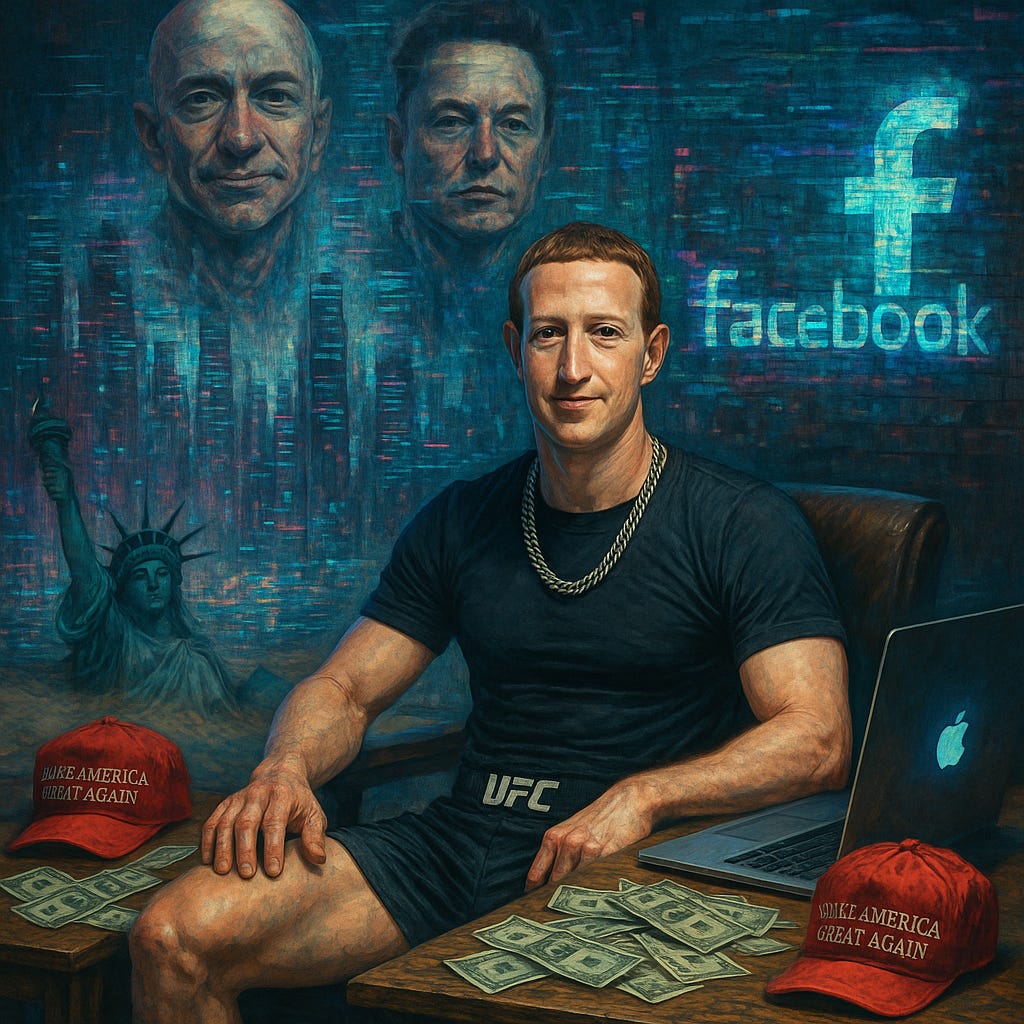
I’ve been struck by the tech sector’s lurch to the right. I’m from Seattle. Growing up, I knew where Bill Gates and Paul Allen lived; remember when Allen bought up an entire derelict district of downtown, built a model of what he wanted it to look like and built it. In many ways, tech people were our hometown heroes (but not at first, Yuppies!). A friend of mine’s father was an early executive at Amazon. I walked into Starbucks one day and saw him looking at something made of plastic and glass, a curious grey and black display. “What’s that?” I asked. “We don’t have a name yet, he said. But imagine this: all your books in the palm of your hand!”
And these people all voted one of two ways. The establishment guys were democrats. The scrappy, punk-rock versions were libertarians. And during the Bush and Clinton administrations this amounted to the same thing for their bottom line. Clinton’s global trade policy allowed for an incredible mobility of labor, granting Apple the discretion to move its entire manufacturing apparatus overseas. And Bush’s market friendly legislation reduced taxes for both tech corporations and the executives who ran them. Simultaneously, the supreme court’s decision on Citizens United politicized all this cash, allowing those executives to back tech-friendly candidates with slushy Super PACs.
Whether you were a libertarian or a democrat, it didn’t matter much. The industry was free—in the Hayekian sense—and growing fast. But nowadays, it's different. Bezos is partying on yachts with his plastic fiancée and the guy I told you about, my friend’s dad, wears cowboy boots and voted for Trump.
Perhaps the arch-symbol of this shift is Mark Zuckerberg. I watch the UFC. And as I tuned in to fights, I started to see him in attendance—this had to have been a couple of years ago. During the prefight promotional documentaries, you’d see him there too, in the gym working out with Israel Adesanya. I stood up from my couch when the middleweight champion of the world yelled at him to jog. It was a cool down round, after all.
And, of course, there was the wardrobe change. Baggy t-shirts. Chains. The same get up he wore when he addressed the Facebook universe about free expression. Early during the Biden administration, the White House pressured internet and social media companies to curtail “misinformation”— “they’re killing people,” Biden said. This pressure led Facebook to institute censors that curtailed speech.
But last year, sitting at a wooden table, speaking directly to the camera, Zuckerberg said, “a lot has happened over the last several years…There's been widespread debate about potential harms from online content. Governments and legacy media have pushed to censor more and more.”
His chain dangling in front of the camera, Zuckerberg admitted, “a lot of this is clearly political… And the recent elections also feel like a cultural tipping point towards once again prioritizing speech.” Many censors would be removed and those remaining would be monitored by teams in Texas where “there is less concern about the bias of our teams.”
But I don’t think this is just a political pivot. What looks like one is something more like an inheritance. The tech CEOs haven’t abandoned neoliberalism for right wing ideology—they’ve inherited its consequences. As the liberal justifications for economics collapses, what remains is power without principle, style without substance. This isn’t a revolt against the system that made them—it’s its final, distorted form. Baggy t-shirts are its uniform.
And this transformation purports to be an ideological shift from where they started as progressives or libertarians. It seems like the cultural dominance of MAGA is challenging the direct rule of neoliberal capital with grass roots ideology. I hear this idea all the time. Francis Fukuyama should be shaking his fist at the sky.
But is that true? I was listening to the Ezra Klien podcast and he was talking to Erica Frantz who, one of many, finds analogues in the Trump story with other populist leaders around the world. And this got me thinking: is ideology making a comeback against neoliberalism in the way people think? Or is it expected as neoliberalism unfolds? Below is a sketch for why we, maybe, shouldn’t be surprised.
The Bezos, Musk, Andreesen, and Zuckerburg transformations signals more than a cultural turn. It reveals how right-wing populism has become the ideological afterimage of neoliberal collapse. What at first looks like an anti-establishment movement—tech MAGA storming the gates of globalism—actually helps entrench the very market logics that got them to where they are. They just don’t understand how they are its product.
Maybe it’s not that history has resumed and ideas have replaced markets; it’s that neoliberalism is completing a circuit. The affective posturing of these tech CEOs, clothed in free speech rhetoric and cowboy boots, doesn’t transcend neoliberalism. It is neoliberalism—shorn of any liberal justification and reduced to the brute exercise of power.
If politics since Nixon have worked to break down the barriers—social, political, cultural—in capital’s way (the removal of the gold standard, NAFTA, importing labor, slack immigration policy), then neoliberal politics have become more autocratic (the growing identification of political capitol with capital-capital). As those with money grow richer under neoliberalism, they gain more political cache. But so do politicians in reverse—they get richer. In other words, markets don’t appear out of no where.
And this has always been true for tech. As Steven Vogel notes in Marketcraft,
The information revolution requires more market governance, not less. Advances in information technology (IT) have dramatically reduced the cost and increased the speed of many market transactions. Yet technology has also created new challenges of market design that defy the government-versus-market dichotomy. The information economy requires more governance because the core commodity—information—is itself the product of rules, such as patent and copyright protection. (Vogel 8-9)
The illusion of a self-regulating information economy has collapsed, and the moguls know it. They’re not free agents anymore. They’re lobbyists in MMA shorts. IT was always beholden to the government. It's just that now it's aware of that fact.
So, the right-wing ideologies we see tech CEOs espousing (like the eminent neutrality of Texas), may not be the end of the end of history. I don’t think they are pandering. The one’s I know are true believers. Rather, it's the vapid pseudo-belief which neoliberalism produces. MAGA just signifies it’s deeper, explicit commitment.
To put it another way, as MAGA reveals the internal operations of neoliberalism—the tensions and mutual cooperation of markets and the politicians who make them possible—it does so with a mandate for politicians to fulfill their obligations to citizens. But this citizenry—including its capitalists— is fractured by those same policies, and so their lives, the very context in which they would develop virtue, are fractured as well. They’ve become fools like the rest of us.
The oligarchs are downstream of this collapse. Their power doesn’t exempt them from the disorientation of post-liberal life—it only lets them stylize it.
From this emerges an ideology set against the classically liberal values which made neoliberalism possible—globalism, cultural pluralism—due to the failure of those values. The tech rebrand in a MAGA aesthetic is a vibe. We might call this Zucker-culture: the performance of value in a world where value no longer has a context. Capitalists used to dress their rhetoric up in the robes of nation and religion. Now they just fill their girlfriend’s breasts with silicone.
Zucker-culture is what happens when neoliberalism disintegrates communal practices—labor, family, religion, neighborhood—through which moral life is formed. It appears in their social media feeds, but also in those of TikTok mumble rappers and Andrew Tate videos, and also, at the same time in the lives of fentanyl-ravaged manufacturing towns—all of which, apparently, voted for Trump. It is the pseudo-morality of the disembodied subject, grasping at abstractions—America, Biblicism, masculinity—branding turned into lived commitments.
And this, of course, is everyone’s problem. It certainly is in the city in which I grew up. In fact, from it, you get a picture of two different Seattle workforces, each undergoing the same effects, the same cultural breakdown, both running to Trump but with differing resources and tribute.
On the one hand, you have union Boeing assembly line workers. These enjoyed a local economy shaped by union protections and fair wages due to their power as manufacturers in a top-down, in house assembly process. However, as the long-term effects of the Taft-Hartley Act and right to work laws sapped their ability to organize, their unions weakened. Boeing subsidized their labor, becoming reliant on contractors and firing its workers. Wages stagnated. Fentanyl, etc. Cue the well-known story of the disintegrating middle class. They and their children, beset by the breakdown of their communities by neoliberal policy, developed what would become Zucker-culture with the moral resources their broken practices gave them, nursing it online, giving Trump their vote.
On the other hand, you have the Seattle tech CEOs. Instead of being the victims of this legislation, they were the benefactors of it. When tech innovation was the sole property of American inventors, they were libertarian or neoliberal democrats. But when they lost control of the AI monopoly with Deep Seek, they ran to the neo-mercantilism Trump was offering. It wasn't an ideological shift; it was a pragmatic one. In a neoliberal, global economy, they could capitalize on their innovation. But, as innovation faltered, they went back to the early 20th century. Markets were never free. It was just that the free market they innovated within suited their needs for the moment.
In this way, the icky, chimeric lostness of Zucker-culture is mirrored in the economic transition of IT markets. Tech CEOs are living the same story as the Boeing employees but in reverse. What they share is a morally bankrupted life and a complete loss of a tradition. And just as the tech CEOs are adopting the signs of that anticulture, they join hands with their lower-class counterparts to sing kumbaya at Mara-Lago. In the end, they are the cultural victims of the economy they profited from and continue to profit from. The new boss is the same as the old one.